Popular

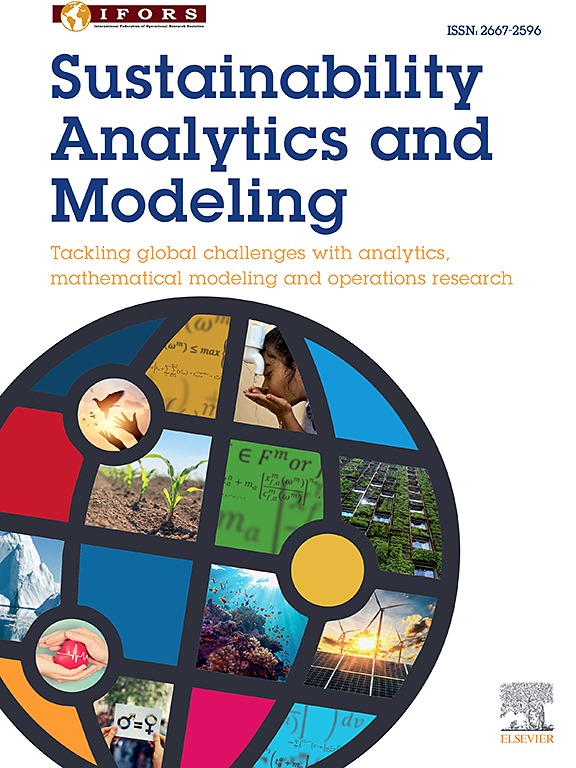
Tackling global challenges with analytics, mathematical modeling and operations research. Published in collaboration with the International Federation of Operational Research Societies (IFORS). The open access Article Publishing Charge (APC) fee will be covered by IFORS.
Sustainability Analytics and Modeling publishes articles that develop and apply quantitative methods of analytics and operations research (OR) to take on global sustainability challenges. These challenges are many and broad in scope. They involve poverty, hunger, health, well-being, education, equality, water, sanitation, energy, economies, industry, infrastructure systems, smart communities, consumption and production, climate, peace, and justice, among other topics, all of which are targeted by the 17 sustainable development goals (SDGs) of the United Nations (https://www.un.org/development/desa/disabilities/envision2030.html).
Published papers contribute through quantitative studies that create deeper understanding of the mechanisms that cause our global sustainability challenges, provide situational awareness or future predictions, uncover interconnections and their role in creating the problem, and develop potential solutions. Papers that develop policy recommendations from quantitative investigation are also encouraged.
Papers published in Sustainability Analytics and Modeling contribute through high-quality mathematical modeling, optimization, data analysis, and other analytical approaches to contending with sustainability challenges. Typical methods include (but are not restricted to): optimization (deterministic, stochastic, multi-level, dynamic, multi-criteria, multi-player,…), mathematical modeling, simulation, forecasting, statistical analysis, and machine learning. Case studies and numerical experiments, when possible, should be based on real world data. Interdisciplinary submissions, from researchers or practitioners, with a quantitative focus are welcome.